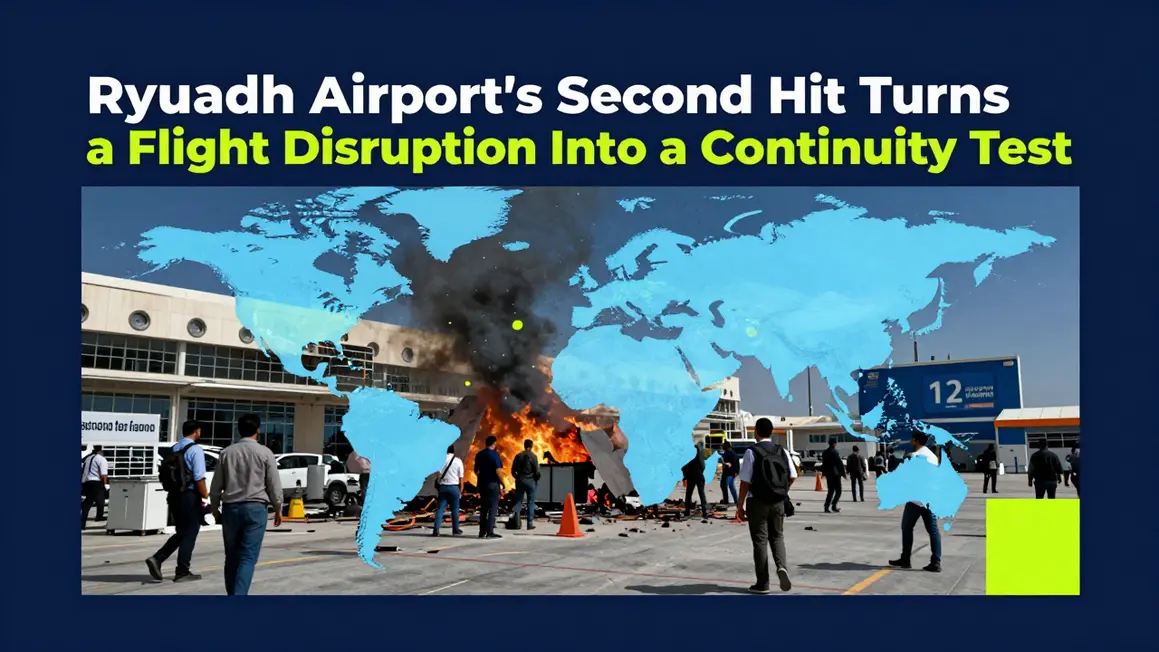
Riyadh's King Khalid International Airport remained closed Sunday after a projectile reportedly struck its passenger-terminal complex, one day after a missile attack killed 12 people and injured more than 300. The second reported hit changes the economic question from whether flights were interrupted to how long airlines and travelers must plan around an uncertain airport reopening.
Saudi authorities suspended airport operations after Saturday's attack and the closure was extended by 24 hours, according to reporting cited by The Associated Press. The latest strike reportedly caused injuries, while the airport remained closed. These facts establish a continuing aviation disruption around Riyadh. They do not establish a measurable increase in U.S. airfares, a regional trade interruption or a shutdown of Saudi oil production. (apnews.com)
The second strike changes the planning horizon
An airport closure creates immediate costs because aircraft, crews, passengers and connecting itineraries are scheduled as a network. When a major airport cannot operate, airlines may cancel flights, divert aircraft, move crews to other locations or hold planes until authorities provide clearance. Travelers can miss onward connections even when the airport they are flying from remains open.
A second reported strike makes a short technical closure less likely to be the only planning assumption. Airlines must consider security reviews, terminal inspections, airspace conditions, staffing and the possibility that service could be suspended again after reopening. That raises the value of flexible tickets and alternative routing, but it does not mean every scheduled flight will be canceled or that all routes through the Gulf are affected equally.
The practical economic effect is therefore uneven. A traveler whose itinerary begins, ends or connects in Riyadh faces direct disruption. A traveler flying between the United States and another destination without a Riyadh connection may see no immediate change. The same distinction applies to airlines: carriers with substantial exposure to the airport face more operational costs than those with no Riyadh service.
Why an airport closure is not automatically an airfare story
Airfares are set through a combination of demand, available seats, fuel costs, competition, booking timing and airline revenue management. A closure can remove seats from a route and raise prices if travelers compete for limited alternatives. It can also reduce demand if people postpone trips, leaving other flights less full. The direction and size of the price effect depend on how passengers reroute and how quickly capacity returns.
The current reporting does not provide a verified U.S. airfare increase. It also does not show that airlines have reduced total regional capacity by a measured amount. Without those data, it would be misleading to convert the closure into a national ticket-price prediction.
Travelers may still incur costs even if fares do not rise. Rebooking fees, extra hotel nights, ground transportation, missed work and lost reservations can matter more than the ticket itself. Businesses sending employees through the region may face scheduling uncertainty and the cost of keeping workers in transit longer. Those are potential consequences of disruption, not measured totals from the reported attacks.
The aviation network is exposed before the wider economy
Riyadh's airport disruption reaches the economy first through travel coordination. Airlines must manage aircraft rotations and passenger connections. Hotels, airport contractors, ground transport providers and travel agencies may see cancellations or last-minute changes. Firms with time-sensitive meetings or regional operations may need to use different hubs or postpone travel.
The evidence does not yet support a broader claim about global supply chains. The reports concern passenger terminals, including terminals 3 and 4 for domestic flights. An airport can be important to business travel without being evidence of a disruption to maritime shipping, oil exports or international freight. Those channels require separate confirmation.
That distinction matters for U.S. households. A person with a Riyadh itinerary may have a practical problem today, while a U.S. consumer shopping for an unrelated domestic flight has no verified reason to expect a fare increase from this event alone. Any broader airfare effect would require sustained closure, constrained alternative capacity and evidence that the disruption was feeding through booking markets.
What to watch before calling it prolonged
The next signals are operational: whether authorities reopen the airport, whether airlines restore scheduled service, how many flights are canceled or diverted, and whether another strike affects the terminal or surrounding airspace. Airline notices and airport operating updates will be more useful to travelers than broad claims about regional risk.
For businesses, the important measure is the duration and geographic reach of the disruption. A one-day closure can be absorbed through rebooking and schedule changes. A prolonged or repeated closure would increase the likelihood of higher travel costs, lost productivity and capacity pressure on alternative hubs.
The second reported strike makes Riyadh's disruption more serious for people who depend on that airport, but it still does not establish a U.S. airfare shock. Travelers should check their specific itinerary and carrier rather than infer a national price movement from the headline. The economic story will become broader only if the closure persists and measurable capacity or booking effects follow.