Layoff Announcements Slow, but Worker Worry Persists
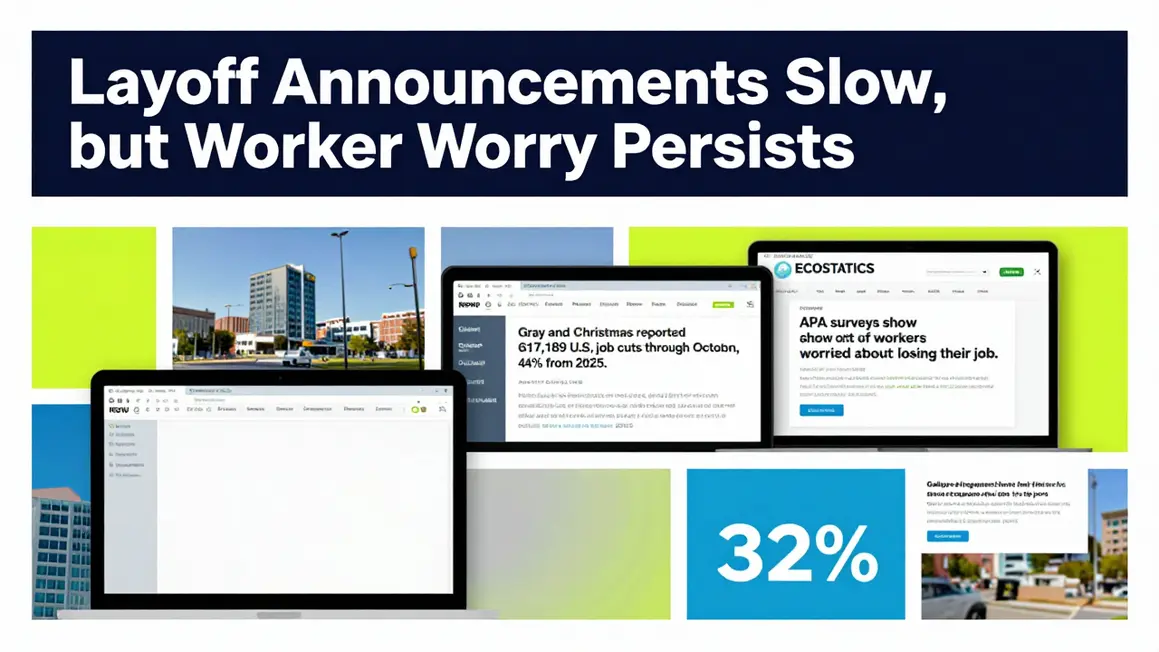
Although U.S. layoff announcements have slowed, the numbers alone do not signal job security. Challenger, Gray and Christmas recorded 617,189 announced cuts through October 2026, a 44 percent drop from the same period in 2025. Yet American Psychological Association surveys of 2,009 employed adults found 32 percent worried about losing their job in the next few weeks or months, up from 26 percent in 2025. Gallup’s U.S. employee engagement index fell to 29 percent in the third quarter of 2026, its lowest level since 2011. Glassdoor’s employee confidence measure reached record lows in September before a slight rebound in October. These figures show fewer notices but no reduction in unease.
Layoff Announcements: A 44 Percent Decline
Challenger, Gray and Christmas data indicate employers announced 617,189 job cuts through October 2026. This total is 44 percent lower than the first ten months of 2025. The report identifies the largest cuts in tech, transportation, and food sectors, with companies citing artificial intelligence as a leading factor. Official numbers report a relatively stable job market with new openings and steady unemployment, yet announced cuts provide one view of planned reductions. The slowdown in notices appears tied to AI-driven shifts rather than a broad return to hiring.
Worker Anxiety: Persistent Concerns
Despite fewer layoff announcements, worker worry remains elevated. The APA spring survey of 2,009 employed adults found 32 percent concerned about losing their job, higher than the 26 percent recorded in 2025. Gallup’s third-quarter 2026 engagement index reached 29 percent, its lowest since 2011. Glassdoor’s confidence measure hit record lows in September 2026 before a modest October rebound but stayed near those lows. These metrics reflect ongoing unease among U.S. workers even as official hiring and unemployment data suggest stability.
AI and Job Reallocation
AI is not simply replacing workers but shifting investment and headcount across projects. Glassdoor chief economist Daniel Zhao explained that companies are reallocating resources rather than eliminating roles outright. He noted, “It doesn’t really matter whether your job can be done by AI or can’t be done by AI. It only matters whether the projects that you’re working on are part of the company’s strategy moving forward in an AI world.” This reallocation creates uncertainty because a role tied to current priorities may lose support if strategy changes.
A case in point involves Briana Taylor, a product marketing manager at Microsoft who felt secure on AI-related work. She received strong performance reviews and a promotion before her June 2025 layoff. She later noted companies may use AI as a scapegoat for broader cost adjustments. Another example is Sam Epperson, a tech sales professional in Colorado Springs who met team goals and was still laid off in early October 2026 after the team missed its annual target. Strong performance does not guarantee security when company strategy pivots.
Uncertainties in the Current Landscape
Looming layoffs create an intensely destabilizing environment where employees may divert energy from creative work to anxiety. Associate professor Jo-Ellen Pozner of Santa Clara University’s Leavey School of Business described this as counterproductive and short-sighted, noting companies face pressure to cut costs without a blockbuster new product. Microsoft offered voluntary buyouts to 60,000 employees in October 2026 just before reporting 19 percent revenue growth. American Express and Barclays announced 5 percent workforce reductions even as consumer spending and credit remained resilient in financial services.
The slowdown in announcements contrasts with these effects. AI-driven reallocation explains part of the drop in notices, but the shift does not eliminate uncertainty. Workers may still face risk if projects no longer align with company priorities. Official data on new jobs and unemployment provide context, yet announced cuts and survey worry highlight the gap between headlines and lived experience.
What to Watch Next
The next Challenger report will clarify whether the October 2026 total marks a sustained trend. APA and Gallup surveys will show if worker worry stabilizes or persists into 2027. Glassdoor’s confidence readings will track whether reallocation effects ease or intensify. Monitoring these indicators alongside AI adoption rates in specific sectors will help distinguish temporary slowdowns from ongoing structural shifts. The 44 percent decline in notices offers one data point, but the persistence of 32 percent worry and 15-year engagement lows shows why numbers alone do not resolve questions of job security.