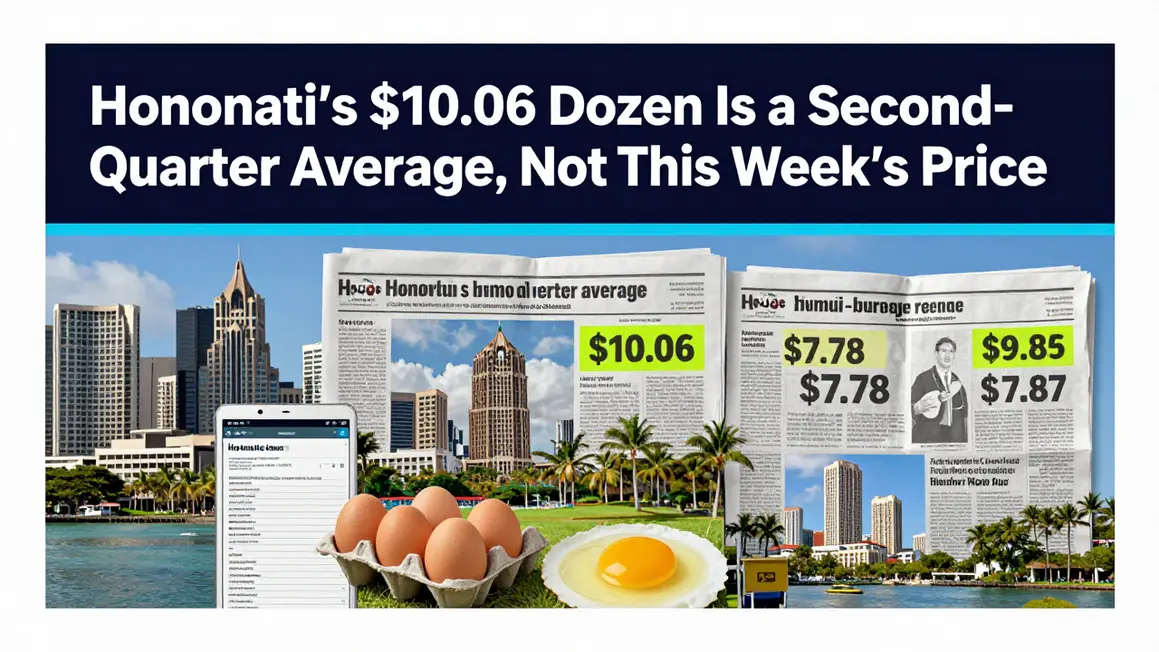
Honolulu’s reported average of $10.06 for a dozen eggs does not tell a shopper what eggs cost this week. The Hawaii Department of Agriculture and Biosecurity posted that figure on October 20, 2026, but the latest data were collected between April 1 and June 30, 2026. It is a second-quarter Honolulu retail average, published more than three months after collection ended, not an October checkout price.
The same release blocks a single eggs-are-up story. Over the year it describes, Honolulu’s dozen average rose from $9.04 to $10.06, while a U.S. continental dozen rose from $7.78 to $7.87. From the first quarter of 2026 to the second, local organic eggs jumped from $10.81 to $13.19 a dozen, while an 18-count carton of local conventional eggs fell from $14.05 to $13.24. No cause is stated.
The posting date is not the survey window
October 20, 2026, is when the department issued the release. April 1 through June 30 is when it says the latest prices were collected. A shopper at a cooler on October 22 is in a later market. The release does not quote that later shelf, name a store, or say whether Honolulu eggs have risen, fallen, or stayed put since June 30.
The $10.06 figure is an average from the Market Analysis and News Branch, not a claim that every buyer paid it on one day. Purchases in the quarter could have landed above or below it. The posted text gives neither the range nor the number of stores, and it does not say how local and continental cartons were weighted. For a U.S. or Canadian household used to a weekly ad, a finished quarterly average cannot be copied into this week’s budget as the sticker on the carton. The release prints dollar prices for Honolulu and the U.S. continent. It is not a Canadian grocery index.
The dozen comparison covers a year, not a week
The release says a Honolulu dozen “spiked more than 11% in the past year, from $9.04 a dozen to $10.06.” The increase is $1.02. Dividing $1.02 by $9.04 gives about 11.3%, which matches that wording. It is not an October inflation rate and not the U.S. or Canadian consumer price index.
During that same span, a continental dozen moved from $7.78 to $7.87. The increase is $0.09. Dividing $0.09 by $7.78 gives about 1.2%, in line with “slightly more than 1%.” Honolulu’s reported dozen rose by a little more than a dollar. The continental comparison rose by nine cents.
The release does not define the earlier endpoint beyond “the past year” and “that same span.” It does not print a 2025 collection calendar for $9.04 or $7.78. Treating those starting prices as a confirmed second-quarter 2025 survey would add a detail the text does not supply.
Subtracting the printed dozen averages shows a gap, not a forecast. In the latest pair, $10.06 minus $7.87 is $2.19. In the earlier pair, $9.04 minus $7.78 is $1.26. The gap between these two published pairs is wider by $0.93. That arithmetic is not evidence about freight, feed, disease, or markups. The release names none of those causes.
Organic dozens and the 18-count moved differently
The other comparisons cover a shorter window and do not agree. Local organic eggs soared 22% from the first quarter of this year to the second, from $10.81 to $13.19 a dozen. The change is $2.38, and $2.38 divided by $10.81 is about 22.0%. Continental organic prices rose from $9.62 to $10.26 over that same quarter-to-quarter span. The increase is $0.64, about 6.7%, which fits “less than 7%.” Those organic changes are not the year-over-year move from $9.04 to $10.06. Merging the windows would make a within-year jump look like the full annual change.
Conventional prices, the release says, fell considerably from the first quarter to the second, by nearly 6% for an 18-count carton of local eggs, from $14.05 to $13.24. The decline is $0.81. Dividing $0.81 by $14.05 gives about 5.8%. The percentage is attached to that carton, not to every conventional egg or every store.
Package size blocks a comparison of totals alone. This per-egg split assumes the printed price divides evenly by the printed count, with no tax, coupon, or damaged egg. Second-quarter $10.06 divided by 12 is about $0.84 an egg. The local organic dozen at $13.19 is about $1.10 an egg. The 18-count at $13.24 is about $0.74 an egg. The larger carton costs more in total because it holds more eggs; on this even split it costs less per egg than the $10.06 dozen average. None of those quotients is an October shelf price.
Buying local is a stated goal, not an explanation
Sharon Hurd, chairperson of the Hawaii Board of Agriculture, urged shoppers to buy local. She said money spent on eggs stays in the islands, pays workers, generates taxes, and supports local food production. It does not explain why the dozen average rose, why local organic eggs jumped, or why the 18-count carton fell.
Tables from the full report are not in the text used here. What would change the reading is a later Market Analysis and News Branch release with its own dates, products, and places. Until then, October 20 remains the posting date for prices collected from April 1 through June 30, 2026: a Honolulu dozen at $10.06, a continental dozen at $7.87, local organic dozens up from $10.81 to $13.19 between the first and second quarters, and the cited 18-count local carton down from $14.05 to $13.24. None of those figures is this week’s checkout.