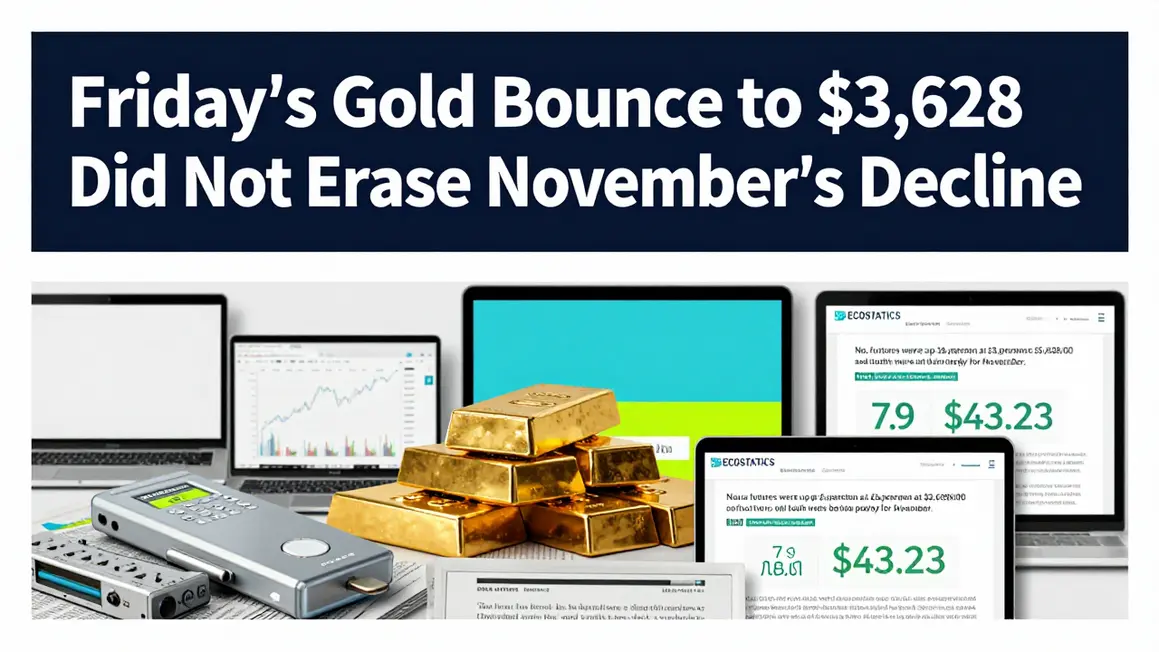
No. Friday's rise in gold and silver futures did not erase November's decline, and it did not change a shop price. On the CNBC live markets page whose address is dated November 26, 2026, gold futures were up 2.6 percent at $3,628.00 an ounce and silver futures were up 7.9 percent at $43.23 an ounce. The same note said the contracts were still down almost 7 percent and more than 12 percent, respectively, in November. A one-day rebound and a still-large November decline can both be true. Neither quote is a jewelry receipt, a grocery bill, or a fuel price.
Friday's note is not a finished November close
The page covers a holiday-shortened week. U.S. stocks were closed Thursday for Thanksgiving, and Friday's stock session ended at 1 p.m. Eastern. A photograph caption on the same page prints Friday, Nov. 27, 2026. The gold-and-silver item is marked "5 Hours Ago." That mark is relative to the time the page was read. It is not a printed clock time, and the metal sentences do not say the figures "closed" or "settled." Equity items on the page do use those words for the stock indexes. The metal levels are therefore the quotes in that live note, not an identified official settlement.
November 27 is also not month-end. Monday, November 30, still falls inside November, so "in November" describes the comparison in this note rather than a completed monthly result. "Almost 7 percent" and "more than 12 percent" are the page's rounded wording.
Daily and monthly percentages use different bases
A daily percentage compares the latest quote with the previous session. The November percentage compares the latest quote with the contract's level at whatever point CNBC used for the month. The page never prints that starting level. Because the bases differ, the smaller daily gain does not cancel the larger monthly loss.
If the printed 2.6 percent were exact, gold at $3,628.00 would imply a prior quote near $3,536.06: 3,628 divided by 1.026 is about 3,536.06, and the gap is about $91.94. If the printed 7.9 percent were exact, silver at $43.23 would imply a prior quote near $40.06: 43.23 divided by 1.079 is about 40.06, a gap of about $3.17. Those reconstructions use the printed percentages only. They are not prices CNBC published, and rounding means the unstated prior quotes could differ.
The month cannot be rebuilt the same way. Dividing $3,628 by 0.93 would pretend that "almost 7 percent" means exactly 7 percent and would invent a starting price. The supported comparison does not need that step. A 2.6 percent daily rise is smaller than a decline of almost 7 percent, and a 7.9 percent daily rise is smaller than a decline of more than 12 percent. Subtracting one percentage from the other would still be invalid, because the rates do not share a base. Friday's bounce did not, on the figures the page actually gave, reverse the November decline.
Silver's bigger daily move is the easier one to overread. It rose more than gold on the day, yet the note still had silver down more than 12 percent in November, a deeper monthly decline than gold's almost 7 percent. A sharper bounce can leave a larger loss in place.
An ounce quote is not a household bill
The note reports futures per ounce. That is a trading quote for a standardized contract. It is not the price a household pays for a ring, a coin, or a bar. A dealer price can include fabrication, a spread, tax, and a brand premium. None of those amounts is in the source. The page shows gold and silver bars in a caption dated April 28, 2025, in Barcelona. It is not a November 2026 receipt, and it states no selling price.
Groceries and fuel are a separate step the page does not take. The metal note never ties the ounce quote to a food index or a pump price. In another item, Brent was last down more than 2 percent to just above $94 a barrel, and U.S. crude was down 1 percent to above $82. Those are oil quotes in that item, not gold, not identified settlements, and not gasoline prices in the United States or Canada. No Canadian-dollar conversion is printed, so $3,628.00 and $43.23 stay in the dollars CNBC printed.
Assume a $1,000 shop price moved exactly with the futures percentage, an assumption the page does not make. Then 2.6 percent would be $26, and 7.9 percent would be $79. Both results are arithmetic on an assumed $1,000. They are not receipts, not a measured pass-through, and not evidence that a register changed on Friday. The note also gives no cause that would show whether a futures move reaches a household at all.
The page states direction, not a cause
The metal item says prices were rising after trending sharply lower this month. That records direction. It does not name a reason. Other updates mention technology shares, a stock bounce, the VIX, oil-infrastructure attacks, and discussion of possible Federal Reserve rate increases after a personal-consumption-expenditures reading. CNBC does not connect those items to $3,628.00 or $43.23. Calling them the cause would go beyond the source.
A later settlement could differ from this live print, so the 2.6 and 7.9 percent figures may be intraday. Monday, November 30, can still change the November comparison. The note cannot reset a repair, grocery order, fuel fill-up, or jewelry purchase already priced.
Watch three figures next: a later settlement rather than this "5 Hours Ago" note; the contracts after November 30, still inside the month; and any separate retail or consumer-price report. Until one of those appears, Friday's rise and November's decline stand together, and no shop price on this page moved.