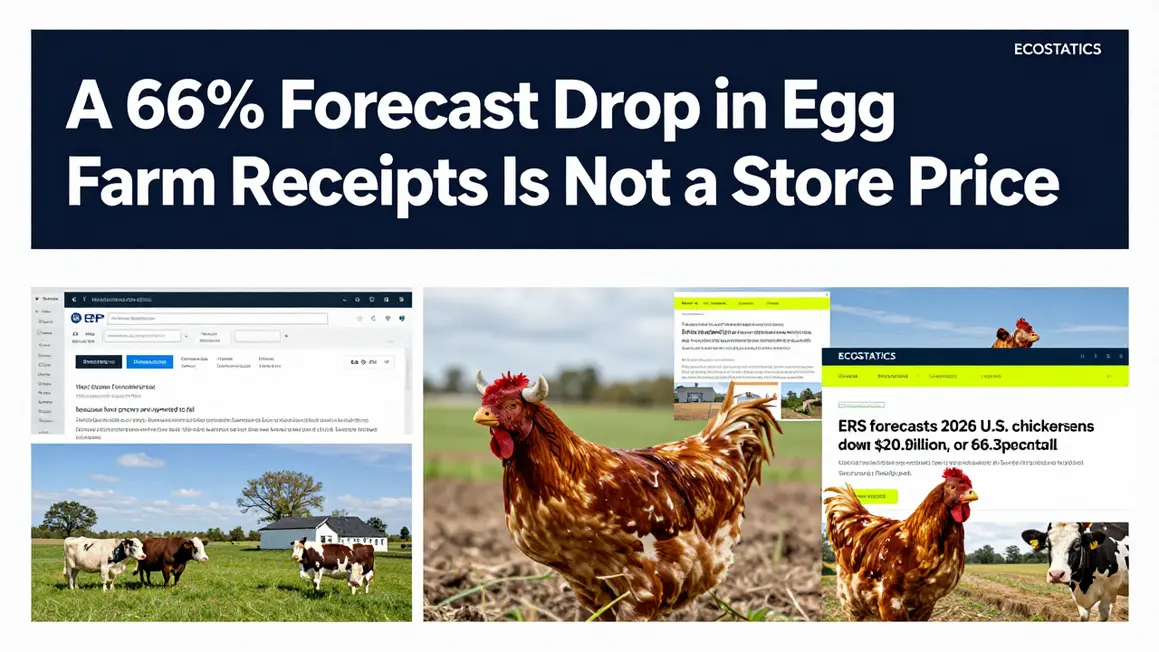
No. A forecast that U.S. chicken-egg cash receipts will drop about 66 percent in 2026 does not mean the grocery price of eggs has already fallen. The USDA Economic Research Service says those receipts are forecast to drop $20.9 billion, or 66.3 percent, because prices are forecast to fall significantly this year. The fetched page prints no carton price, no dozen price, and no release date. Checked November 14, 2026, these figures are expected national farm sales for a year that was still unfinished, not a charge a shopper has already paid.
Farm cash receipts are not a grocery receipt
Cash receipts in this forecast are dollars U.S. farms are expected to receive for crops and animal products. An egg receipt is farm sales value, not a carton price in a U.S. or Canadian grocery store and not a household checkout total. ERS generally states year-to-year changes in nominal dollars, not adjusted for inflation, and notes where inflation adjustment reverses the direction. The egg decline is nominal. The page does not convert it into a retail price index.
Forecast, projected, and expected describe 2026 outcomes that were not final on November 14. In the egg sentence, this year belongs to that 2026 forecast. An expected drop in the price farms receive is not evidence that a store price has already fallen.
Eggs account for the animal-receipt drop
After a record high in 2025, animal and animal-product cash receipts are forecast at $287.3 billion in 2026, a nominal decrease of $16.4 billion, or 5.4 percent. ERS says falling chicken-egg receipts are expected to contribute most of that decline. Eggs are forecast down $20.9 billion, or 66.3 percent. Other lines move both ways. Cattle and calf receipts are projected up $7.0 billion, or 5.2 percent, because cattle prices are expected to keep rising. Turkey receipts are expected up $2.0 billion, or 35.1 percent, on rising prices. Milk is forecast down $2.1 billion, or 4.3 percent, on lower prices. Hog receipts are expected down $1.2 billion, or 4.0 percent, and broiler receipts down $1.3 billion, or 2.8 percent.
Gains of $7.0 billion for cattle and $2.0 billion for turkeys, set against those other declines, leave a net drop of $16.5 billion. The printed animal decline is $16.4 billion. The $0.1 billion gap is arithmetic on rounded published lines, not another commodity and not a grocery discount. In inflation-adjusted dollars, animal receipts are expected to fall $25.5 billion, or 8.1 percent. The page does not restate the egg change after inflation, so 66.3 percent is not an after-inflation cut in a store price.
A farm price is only one step toward the shelf
A receipt changes with price, quantity, or both. For eggs, ERS cites prices forecast to fall significantly and does not cite fewer dozens sold. Corn receipts are expected up $6.8 billion, or 11.3 percent, mainly because more is sold. Cattle receipts are tied to rising prices, so one percentage does not describe the same event everywhere. A lower farm price is not yet a lower grocery price. Packing, transport, and retail margins sit between the producer and the household, and this page prints none of those amounts. A shopper in the United States or Canada cannot read 66.3 percent as a discount already taken off a carton.
A labeled hypothetical shows the mismatch. Assume a dozen cost $4 and cut that assumed price by 66.3 percent. Four times 0.663 equals 2.652, and 4 minus 2.652 equals 1.348, about $1.35. The source never states $4, and 66.3 percent applies to national farm receipts, not to one retail unit. About $1.35 is not a forecast and not a store price. Higher cattle and turkey receipts likewise do not show that beef or turkey already costs more at the store. They forecast higher farm prices and higher farm sales.
The profit forecast does not price a carton
Egg receipts are one part of a wider 2026 income forecast, and that forecast is not a grocery bill. Nominal net farm income, a broad profit measure, is forecast at $158.4 billion, down $4.3 billion, or 2.6 percent. Net cash farm income is forecast at $176.4 billion, up $0.7 billion, or 0.4 percent. In inflation-adjusted 2026 dollars, net farm income is instead forecast down $9.1 billion, or 5.5 percent. Total cash receipts are forecast at $540.3 billion, down $1.7 billion, or 0.3 percent, in nominal dollars. Crop receipts are forecast up $14.6 billion, or 6.1 percent, to $253.0 billion. Animal receipts fall, chiefly because of eggs. Direct government payments are forecast at $47.4 billion, up $19.5 billion from $27.9 billion. Production expenses, including operator dwellings, are forecast up $21.2 billion, or 4.5 percent, to $492.8 billion.
The $20.9 billion egg decline is far larger than the $4.3 billion nominal profit decline, but other receipts, payments, and expenses move too. A receipt line is not farm profit, and neither figure is a carton price. Conservation payments are printed at $5.3 billion, up $757.9 million, or 16.9 percent. The next sentence stops at an increase in pay and is not completed here.
Evidence that grocery egg prices fell would be a dated retail price or a consumer price index for eggs. This page has neither. The 66.3 percent figure remains a 2026 forecast of U.S. farm cash receipts, tied to farm prices expected to fall significantly, and the year was still open on November 14. Watch whether a later update keeps the $20.9 billion egg decline and separates price from quantity, and whether a retail series, not this page, shows carton prices moving. Cattle receipts, forecast up $7.0 billion because cattle prices are expected to rise, need the same reading.