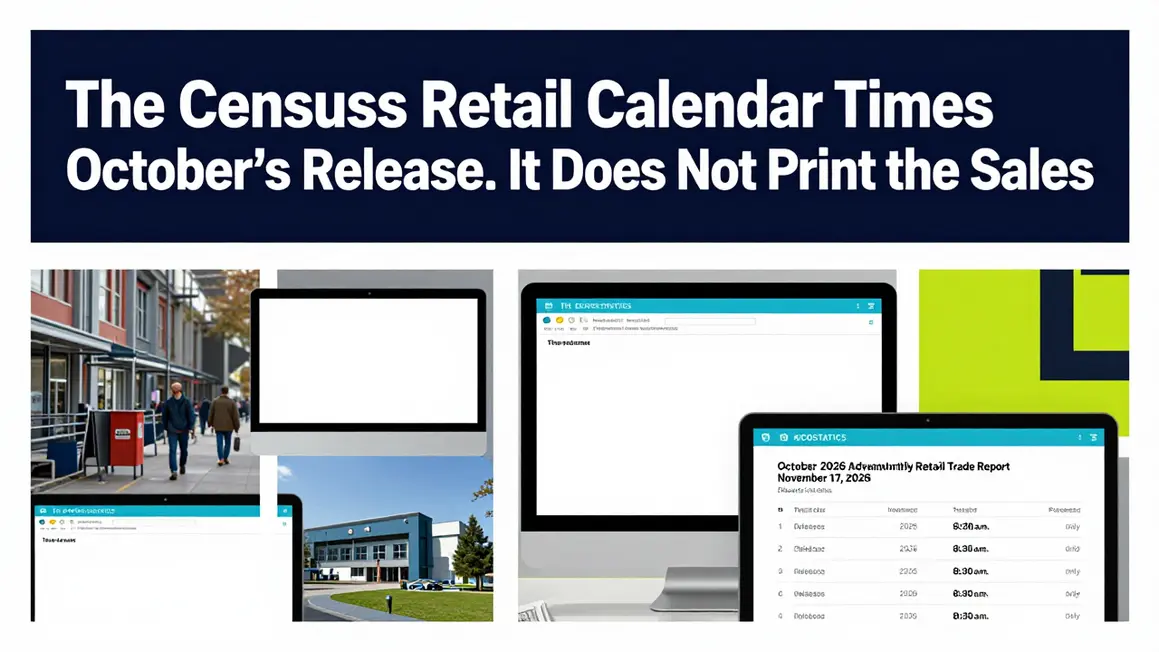
A release time is not an October sales total
No. The U.S. Census Bureau's monthly retail release schedule does not say whether October 2026 sales rose. The page checked on November 17, 2026, lists release dates and clock times. It does not print an October sales total, a percent change, a store price, or a hiring figure.
The timing makes the mix-up easier. The schedule places the October 2026 Advance Monthly Retail Trade Report on November 17, 2026, at 8:30 a.m. This reading was made that same day, at about 5:15 p.m. New York time, after the printed morning hour. The page still showed a timetable. A listing can tell a household or a retailer when a report is due. It cannot say whether spending went up.
Dates the 2026/2027 page actually shows
The fetched page is the Monthly Retail Trade release schedule, headed "Release Dates for 2026/2027." It says files are available as Excel and that all files are under 1 MB. It then prints three calendars: the Advance Monthly Retail Trade Report, the Monthly Retail Trade Report, and the Quarterly Retail E-Commerce Report. Each visible row pairs a data period with a release date and a time. None pairs a period with a dollar estimate.
On the advance table, the stated time is 8:30 a.m. September 2026 is listed for October 15, 2026. October 2026 is listed for November 17, 2026. November 2026 is listed for December 16, 2026. The rows continue through November 2027, listed for December 15, 2027. December 2027 is "To be announced at a later date." The fetch does not put a time zone beside "8:30 a.m.," so this article does not add one.
The page also links to historical release dates in Excel. Those files were not included in the fetch. Their contents are not treated here as October sales estimates. What this check can use is the visible calendar.
One data month, more than one appointment
October 2026 is not a single line, and the extra lines are still dates. The advance report for that month is the November 17, 2026, entry at 8:30 a.m. The separate Monthly Retail Trade Report lists October 2026 for December 16, 2026, at 8:30 a.m. for sales and 10:00 a.m. for inventories. December 16 is another scheduled time for the October data month. It is not a sales total printed on this page. The page does not say whether that later report revises the advance, so this article does not say so either.
Neighboring rows show why a shared day is not a shared statistic. The September 2026 advance report is dated October 15, 2026, while the monthly report for September 2026 is dated November 17, 2026, the same day as the October advance, but a different data month. The November 2026 advance report is dated December 16, 2026, the same day as the monthly report's October line. Matching dates do not merge the rows.
E-commerce is a third calendar. The Quarterly Retail E-Commerce Report lists the third quarter of 2026 for November 19, 2026, at 10:00 a.m., and the fourth quarter of 2026 for February 19, 2027, at 10:00 a.m. Those are quarterly appointments. The page prints no online sales figure and no store-sales figure next to them.
What a household or a shop cannot learn from a timetable
A rise or a fall in sales needs a comparison: one estimate against another, or a published change. The schedule has neither. It names the month a report covers and the day that report is due.
For a household, a grocery receipt or a postponed purchase is not this national calendar. Even if a later results page issues the advance report, that document would still be separate from one household's receipt. This schedule page is not that estimate. Checking it at 8:30 a.m., or again in the afternoon of November 17, does not turn the listing into news that U.S. spending rose in October.
A business faces the same limit. The calendar cannot show whether one shop's October sales matched a national move, because it shows no national move. It also prints no payroll or hiring figure. Reading "November 17" as evidence of stronger demand treats a production schedule as a spending result.
A labeled hypothetical shows how large that leap is, without using it as data. Assume a shop's October sales were $10,000, and assume someone treated the calendar date as proof of a 1 percent national increase, then applied that rate to the shop. One percent of $10,000 is $100. None of those figures appears on the page. The $100 is only arithmetic on assumed inputs, and the assumption is unsupported.
Later rows make the same point forward. Advance dates are already printed from January 2027 through November 2027, while December 2027 is still to be announced. Those future dates are a publication plan. They are not estimates of spending this page has not reported.
Evidence still to come
This calendar leaves October's direction unsettled. Silence on a sales total is not evidence that sales were flat, and it is not a price or a hiring result.
The dates worth watching are the ones the page does print. The October 2026 advance report is listed for November 17, 2026, at 8:30 a.m. The monthly report listing October 2026, with sales at 8:30 a.m. and inventories at 10:00 a.m., is December 16, 2026. The third-quarter e-commerce report is November 19, 2026, at 10:00 a.m. Whether October sales rose can be answered only by the estimates those releases print, and by any later label that a figure is preliminary or revised. This schedule applies no such label to a sales number, because it prints none.
Until a results page supplies the October estimate, the supported reading is procedural. The calendar times the release. On this page, Census has not reported the sales.