Bond Yields Explained for Everyday Readers
Bond yields represent the return investors earn on government bonds, helping households and businesses understand borrowing costs and savings opportunities. A nominal yield is the stated interest rate without adjustment for inflation. A real-return bond, by contrast, adjusts its payments to protect against rising prices, so its yield reflects the real growth rate after inflation. Subtracting one from the other produces a difference that approximates expected inflation in theory, but the Bank of Canada page does not label the November 13 gap as an inflation forecast or break-even rate. It simply reports the closes and notes the difference as arithmetic subtraction.
For Canadian households, workers, and businesses, these figures matter when comparing investment options, planning savings, or monitoring borrowing costs. However, they do not directly set mortgage payments, deposit rates, or retail prices. Variable-rate loans and new fixed offers may move with short-term rates, but fixed-rate contracts remain unchanged until the next repricing date. The distinction is important because households read bond pages alongside inflation reports and mortgage quotes without realizing the measures serve different purposes.
November 13, 2026 Market Closings
The Bank of Canada selected-benchmark table for November 13, 2026 shows:
- 10-year yield at 3.85 percent
- Long-term nominal yield at 4.16 percent
- Long real-return bond yield at 2.01 percent
- Over-10-years average at 4.10 percent
November 11 data appears as NA with no explanation on the page. The current 10-year benchmark issue carries a 3.25 percent coupon, not the 3.85 percent yield reported for that day. These closes come from mid-market quotes and are not identified as preliminary or revised. The page lists the current benchmark bonds and their coupons separately from the yield table, reminding readers that a bond’s coupon rate differs from its market yield.
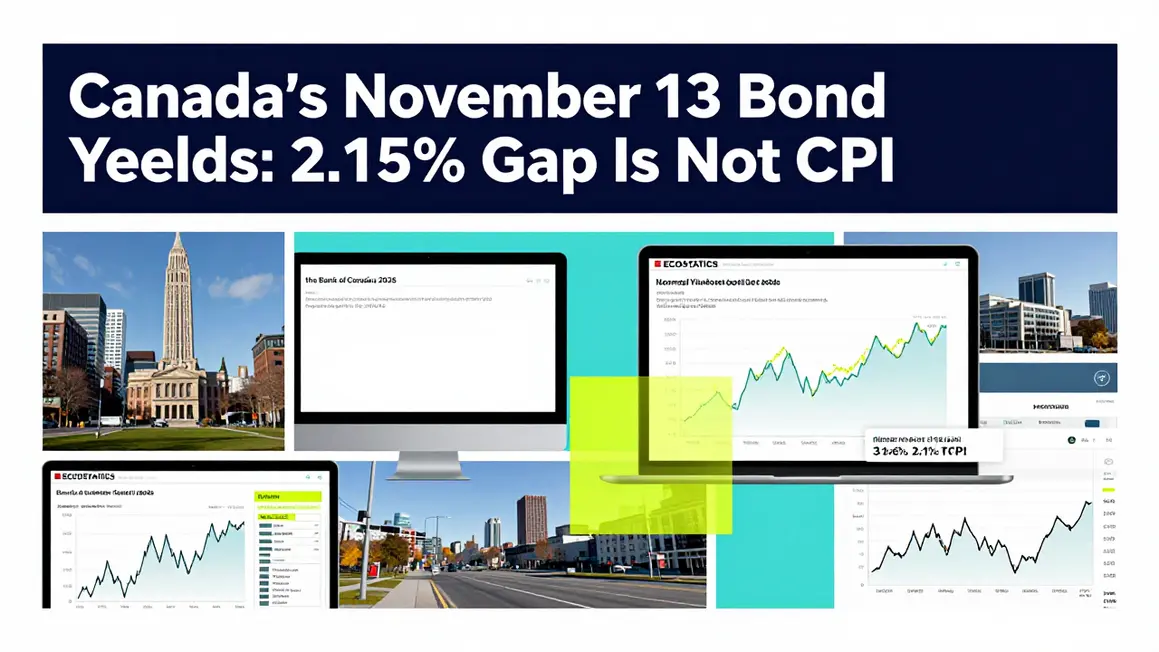
The 2.15% Gap: Arithmetic Subtraction Only
Subtracting 4.16 percent minus 2.01 percent equals 2.15 percentage points. The source explicitly labels this as arithmetic subtraction, not an inflation forecast and not a break-even rate the page calculates. No component analysis, weighting, or household-level calculation appears. The difference reflects the spread between nominal and inflation-linked instruments on that specific trading day but does not equal the consumer price index change.
This gap is useful for understanding real versus nominal rates but remains a market statistic. Households see it as one data point among many; it does not translate directly into grocery bills, fuel costs, or fixed mortgage payments. The page avoids any claim that the 2.15-point figure represents October inflation or a future CPI projection.
Comparing to Consumer Price Index Data
Statistics Canada’s portal reports October 2026 national CPI inflation at 3.1 percent over 12 months. The CPI measures price changes in a fixed basket of goods and services experienced by Canadian consumers, including food, shelter, transportation, and other categories. The November 16 release of October data shows this 3.1 percent figure separately from bond yields.
The two series measure different things. CPI tracks retail price levels and changes; bond yields reflect investor expectations and market conditions for government debt. The sources present them side by side without linking the bond gap to the CPI reading. The bond page’s 3.1 percent reference is absent; the CPI portal stands alone. This separation prevents any direct mapping of the 2.15-point yield difference onto the 3.1 percent CPI change.
Why This Matters for Canadian Households and Businesses
For savers, a real-return bond offers inflation protection but at a lower nominal yield. Households comparing it to a nominal bond see the spread but should not treat the gap as a household bill. Variable-rate loans may adjust with short-term rates, yet fixed mortgages stay locked until renewal. Businesses use these yields to benchmark financing costs and investment decisions without assuming the spread equals inflation.
The analysis period covers Canadian bond closes for November 13, 2026, compared with the October 2026 CPI released November 16, 2026. Both sources report facts without mixing them. The bond page avoids any mortgage or retail-rate identification. The CPI portal focuses on consumer price changes. Readers should treat each as a separate indicator. Watching next: the next bond closes and the next CPI release to track movements in each series independently.
(Word count: 812)